Who Gets to Steal? Copyright, Collage, and the Art World's Selective Enforcement
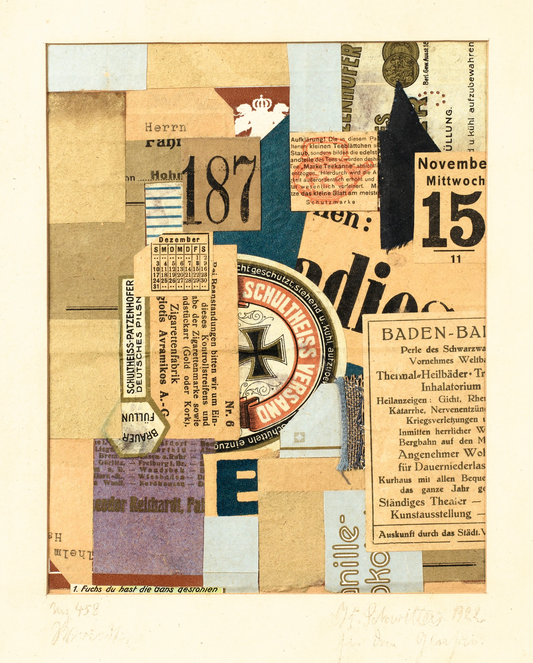
Collage: Kurt Schwitters | MERZ 458 WRIEDT (1922)
I saw a post in a collage art group a couple of weeks ago that made my blood boil, and I can't stop thinking about it.
An artist lost their show at a senior citizens center. Not because their work wasn't good. Not because it wasn't appropriate. But because the venue manager was afraid of copyright lawsuits. The artist had created beautiful mixed-media pieces using magazine images and photographs, including some recognizable faces like Frida Kahlo. They asked the group: Should I just show work without recognizable faces? Will that solve the problem?
Here's what I wish I could tell them (and what I'm telling you now): Hiding faces won't fix this. And honestly, this whole situation reveals something deeply broken about how copyright gets enforced in the art world.
Before I go further, full transparency: I've made Frida work too. I've used found imagery in my collages. I'm not writing this from some imaginary moral high ground. I'm writing as someone who's navigating the same murky waters, trying to understand a system that feels fundamentally unfair.
A quick note on jurisdiction: I’m primarily referencing US copyright law here, especially the concept of fair use and the 2023 Warhol v. Goldsmith decision. If you’re in Canada (like me), Australia, or other Commonwealth countries, you’re dealing with “fair dealing,” which is generally more restrictive. European copyright systems differ again. The broad principles overlap, but the specifics vary by country. Where you live and where you sell matters.
Copyright Protects the Photograph, Not the Face
Here's something I see artists suggest all the time: "What if I cut up the face and reassemble it so it's not recognizable anymore? Then it's not copyright infringement, right?"
Wrong.
Copyright isn't about whether someone's face is recognizable. It's about whether you used someone else's copyrighted work without permission.
What copyright actually protects is the photograph itself — not the subject's identity, but the photographer's creative expression: composition, lighting, angle, the moment captured.
And protection is automatic, from the moment of creation. That photo from a 1995 yearbook? Copyrighted. The photographer (or school/yearbook company) owns it, and it won’t enter the public domain for decades.
It doesn’t matter who’s in the photo. Famous person, unknown person — copyright protection isn’t based on fame.
So if you take that photograph of Frida and cut it into pieces, cover half her face, or reassemble it so it looks nothing like her — you’ve still used that photographer's copyrighted work without permission.
There’s also a separate legal concept called “right of publicity,” which protects living people from unauthorized commercial use of their likeness. That varies by jurisdiction and is distinct from copyright. For deceased historical figures like Frida Kahlo, right of publicity may or may not apply depending on location. In many places it expires at death, but in some regions it can extend posthumously. The copyright issue, however, relates to the photographer’s work, not the subject’s identity.
Making faces unrecognizable doesn’t solve the copyright problem. It just makes your source material harder to trace.
What About Fair Use?
You've probably heard about “fair use,” the doctrine that allows some unlicensed use of copyrighted work. Maybe you've heard that if your work is “transformative enough,” you're protected. The problem is that “transformative” has a specific legal meaning.
The Supreme Court ruled on Andy Warhol Foundation v. Goldsmith, and while the decision didn’t eliminate transformative use, it clarified that visual change alone isn’t enough — especially when commercial licensing is involved. Warhol had taken a photograph by Lynn Goldsmith and turned it into his signature pop art style. After Prince died, the Warhol Foundation licensed one of those images for a magazine cover.
Goldsmith sued. The Supreme Court ruled 7–2 against the Warhol Foundation.
The Court said that even though Warhol visually transformed the image, the licensing served essentially the same purpose as the original photograph; illustrating an article about Prince. That specific commercial use wasn’t fair use.
The ruling was narrow and fact-specific. But it clarified something important: courts aren’t just asking whether you changed how something looks. They’re asking whether you changed its purpose. For collage artists, that’s sobering. Because changing the surface isn’t the same as changing the purpose.
So How Could Collage Be Fair Use?
If you’re working with appropriated imagery and want to argue fair use, purpose matters. Meaning matters.
If the original photograph was documentary or promotional, like showing what someone looked like, and your collage uses that image to comment on cultural iconography, celebrity worship, consumerism, or identity, that’s a stronger argument for transformation.
In my own work, I’m not trying to reproduce Frida Kahlo or create a new portrait of her. I’m building layered compositions that explore themes of heritage, sacred symbolism, and feminine power — the image becomes one element in a larger narrative shaped by the visual language of collage. The finished piece serves a different purpose than the original photograph.
Integration matters. Context matters. Market substitution matters. Would someone buy your collage instead of the original photograph? Almost certainly not.
This often begs the question whenever copyright and collage collide: If you know how to draw and paint, why bother with collage at all?
I can draw. I can paint. That isn’t the point.
Collage lets you work with material that already carries time inside it. A 1929 newspaper headline isn’t just text, it holds typography, ink, context, the atmosphere of the moment it was printed. When you place it beside something contemporary, meaning doesn’t get illustrated, it emerges.
Collage is thought built from fragments, juxtaposition as language. It collapses time. It allows images from different eras to clash, harmonize, contradict, and amplify each other. You discover connections by physically rearranging cultural debris. Meaning surfaces in layers. Sometimes you don’t even know what the piece is about until two fragments unexpectedly lock together and refuse to be separated. Collage works because the materials already lived.
But here’s the hard truth: even with strong arguments, there’s no guarantee. Fair use is a defense raised in court. It’s expensive. It’s subjective. And it’s evaluated case by case.
So How Did Warhol Get Away With It?
Warhol’s appropriation work was never definitively ruled to be fair use during his lifetime. He mostly just… got away with it. He was sued. Some cases were settled. Some rights holders didn’t pursue action. He had gallery backing, legal counsel, and money. He died in 1987, and now statute of limitations shields much of his work from challenge.
His art still hangs in museums. It still sells for millions. Not because a court declared it universally legal but because he had the resources and cultural capital to withstand risk. Apparently, being Andy Warhol was a more effective strategy than citing fair use.
The Visibility Paradox
There are successful artists showing work that uses copyrighted imagery right now. Artists whose work sells for five figures. Artists with high-end gallery representation. Artists in museums. Walk into certain galleries and you’ll see paintings featuring Marilyn Monroe, Spider-Man, luxury brand logos. These pieces sell. They hang in collectors’ homes. Lawsuits are rare.
The legal framework is the same whether you're showing at a senior centre or in your own gallery. What’s different is who’s taking the risk, what resources they have if something goes wrong, and how much attention the work attracts.
The Uncomfortable Truth About Enforcement
Copyright enforcement is selective.
It depends on money.
It depends on visibility.
It depends on who owns the copyright.
It depends on who notices.
It depends on luck.
Large entertainment companies have famously sent cease-and-desist letters to preschools over unlicensed character murals. Other brands appear far more selective about when enforcement is worth their time. There is no safe threshold, no formula, which is why galleries across the world show appropriation work without issue while a collage artist loses a community show.
Why Venues Say No
I understand why the senior center said no. Non-profits and community venues can’t afford even a frivolous legal threat. Even responding to a cease-and-desist letter costs money. And if a rights holder pursued action, the venue could be named alongside the artist because they are publicly displaying the work. So they avoid risk entirely. It isn’t about artistic merit. It’s about liability.
…And Then There’s AI
Artificial intelligence complicates everything.
You can generate an AI image of Frida Kahlo in seconds. No identifiable photographer. No magazine clipping. Would using that AI-generated Frida reduce certain copyright risks tied to identifiable photographers? Possibly. But it introduces new uncertainties, and we’re still in uncharted territory.
AI platforms operate under their own licence terms. Ongoing lawsuits question how training data was sourced. Different jurisdictions may treat AI-generated work differently. It doesn’t eliminate grey areas. It shifts them. For some artists, AI feels like a workaround. For others, it feels like participating in a different ethical contradiction.
The landscape is getting murkier, not clearer.
Practical Considerations
If you work with found imagery, you’re operating in a grey area.
Public domain images are generally safe. In the US, works published in 1930 or earlier are in the public domain as of 2026. For older works, the rule is typically 95 years after publication for works published before 1978. This varies by country — Canada and many others use life of the creator plus 50 years (or 70 in some jurisdictions). Always check the rules that apply where you live and sell.
“Cut me up” books have individual licensing terms. Don’t assume they allow all uses.
Commercial licensing increases exposure.
And if your work begins generating significant income, consult an art and copyright lawyer.
The Bigger Picture
Copyright was designed to protect creators. In practice, it often protects those who can afford to defend themselves. The framework is the same whether you are exhibiting at a community centre or represented by a blue chip gallery. The consequences are not. That disparity shapes what gets challenged, what gets ignored, and what quietly becomes canon.
Final Thoughts
Collage questions ownership. It questions authorship. It exposes how culture circulates, mutates, and resurfaces. It works with fragments because culture itself is fragmented. It builds meaning from what already exists because meaning is rarely born in isolation. That discomfort is not a flaw. It is part of the medium.
Create boldly.
Disclaimer: I'm an artist, not a lawyer. This article reflects my personal experience and research navigating copyright as a working collage artist. It does not constitute legal advice. Copyright law varies significantly by jurisdiction, and individual cases can be complex. If you're facing a specific legal question, consult a qualified attorney in your area.